
Isotopic Anomalous Fingerprinting: A Forensic Standard for Materials That Defy Known Processing
When standard materials analysis reaches its limit, isotopic gradients tell a different story.

Kevin Thorsen Baird
Principal Investigator // Baird Research & Strategic Sciences, LLC
Director, The C4 Institute // ORCID: 0009-0001-7938-446X
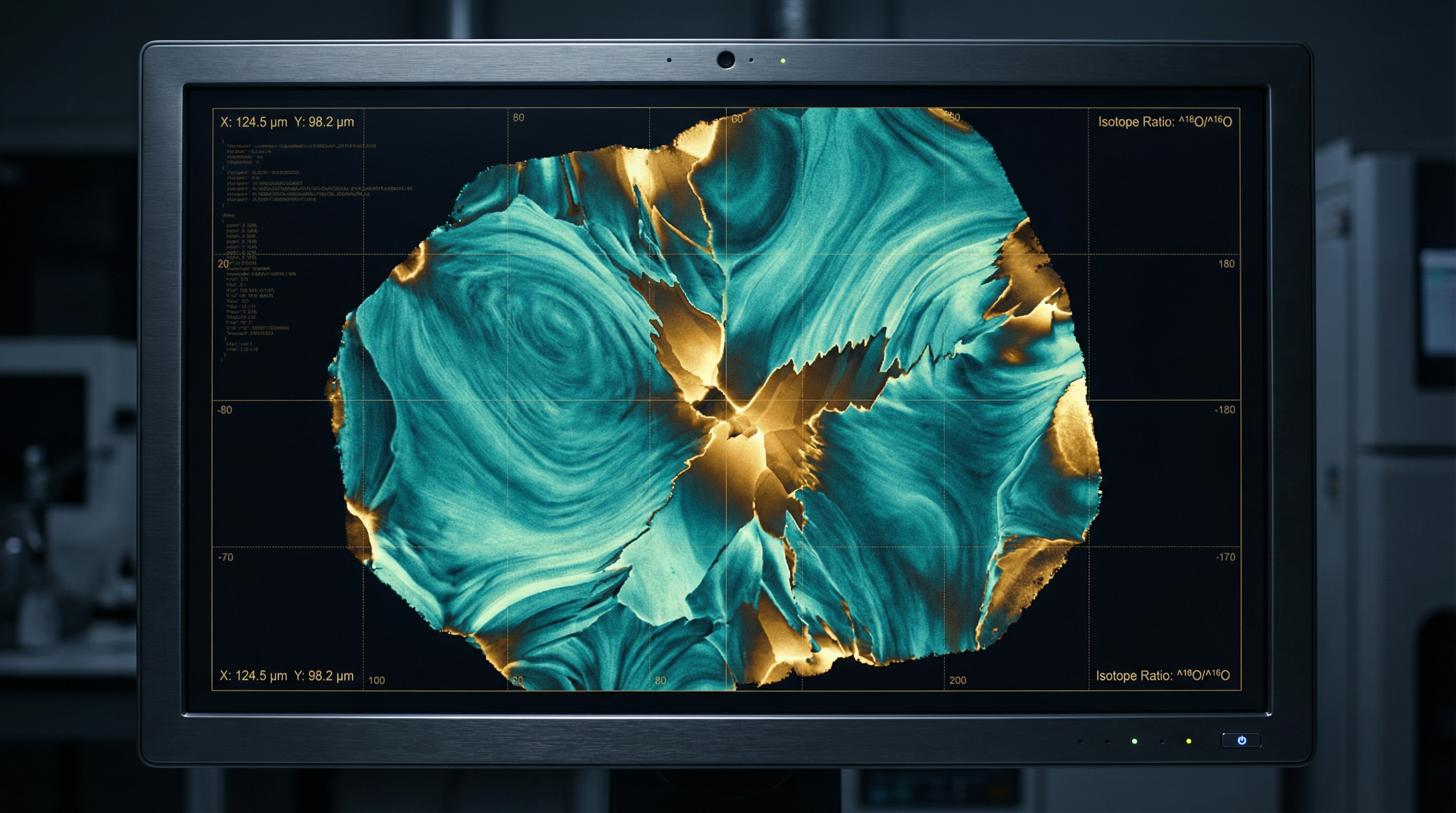
NanoSIMS false-color isotopic map // anomalous isotopic zones in metallic grain cross-section // BRSS Aerospace Forensics
Forensic materials science has long relied on a practical assumption: that the elemental composition of a recovered sample is sufficient to establish provenance. If the iron content matches known industrial alloys, the material is industrial. If the isotopic ratios fall within terrestrial norms, the origin is terrestrial.
This assumption holds reliably for the overwhelming majority of materials encountered in defense, aerospace, and semiconductor supply chain contexts. It fails, however, in a specific and important class of cases — materials formed or processed under conditions of extreme non-equilibrium thermodynamics, where standard melt-phase mixing does not apply.
Isotopic Anomalous Fingerprinting (IAF) is the forensic methodology developed at BRSS to address precisely this gap.
The Problem With Standard Isotopic Analysis
Conventional isotopic analysis establishes whether a sample's elemental ratios are consistent with known natural or industrial processes. It answers the question: does this material look like what we expect?
What it does not answer is a subtler and more forensically significant question: how far does this material deviate from every known processing pathway, and is that deviation statistically meaningful?
The distinction matters because certain formation conditions — rapid condensation from plasma, extreme radiation environments, or processing under non-equilibrium pressure-temperature regimes — produce isotopic gradients that no known industrial process replicates. A sample emerging from such conditions will pass a standard elemental composition check while carrying a hidden signature that standard analysis was never designed to detect.
IAF was developed to detect that signature.
The D_iso Coefficient: A Standardized Deviation Metric
The methodological core of IAF is the Isotopic Drift Index, or D_iso. The formula is straightforward:
Where I_obs is the observed isotopic abundance for each isotope of interest, and I_std is the established terrestrial or solar standard abundance for that isotope.
The result is a single normalized coefficient representing the cumulative deviation of a sample's isotopic profile from all known natural baselines simultaneously.
The threshold structure is as follows:
This threshold is not arbitrary. It is derived from the statistical distribution of isotopic ratios across the published NanoSIMS literature for known industrial, meteoritic, and presolar grain samples. A D_iso value above 0.5 places a sample outside the three-sigma boundary of every known terrestrial processing pathway in that dataset.
Why This Matters as a Broad Forensic Standard
The IAF methodology was designed from the outset to be material-agnostic and application-agnostic. The D_iso coefficient does not require knowledge of what the material is, where it came from, or how it was allegedly processed. It requires only a high-precision isotopic measurement — obtainable via NanoSIMS, SIMS, or equivalent secondary ion mass spectrometry — and a comparison against established standards.
This makes IAF applicable across several distinct domains:
Hardware Assurance & Supply Chain Integrity
In semiconductor and defense procurement contexts, isotopic gradients can serve as authentication markers that are orders of magnitude harder to spoof than elemental composition alone. A component manufactured under known controlled conditions will carry a predictable isotopic profile. Deviation from that profile is a forensic flag.
Recovered Anomalous Materials
For samples of uncertain provenance — including materials recovered in aerospace forensic contexts — IAF provides a standardized, reproducible metric for establishing whether the formation pathway is consistent with any known industrial or natural process. This moves the analysis from qualitative description to quantitative falsification.
Astronomical Remote Sensing
Where direct sample return is not possible, spectroscopic data can be analyzed for isotopic ratios in specific elemental systems. The D_iso framework applies equally to remotely sensed data, allowing the same falsification threshold to be applied to objects that cannot be physically recovered.
Demonstrated Application: The Ubatuba Magnesium Fragment
The initial demonstration case for IAF methodology is the Ubatuba magnesium fragment, a sample with extensively documented anomalous properties in the existing literature. Applying the D_iso coefficient to the published isotopic data for this sample yields a value of approximately 0.77 — well above the 0.5 falsification threshold.
This result does not, by itself, establish the origin of the material. What it establishes, rigorously and reproducibly, is that the isotopic profile of this sample is inconsistent with formation via any known industrial melt-phase processing pathway. That is a forensically meaningful statement, independent of any interpretive framework applied to it.
The calculation is fully reproducible using the open D_iso calculator available at bairdstrategic.com/aerospace-forensics.
Proposed Next Steps Toward Formal Validation
IAF is currently at the preprint and patent-pending stage. The methodology is protected under USPTO provisional application 63/929,089. The next steps toward formal validation are:
- Direct application to raw NanoSIMS datasets beginning with Powell et al. (2022) and comparable published sample archives, to establish a broader empirical baseline for the D_iso threshold structure.
- Independent replication by researchers with access to NanoSIMS or SIMS instrumentation and relevant sample archives.
- Peer-reviewed publication of the full methodology and threshold derivation in a materials forensics or analytical chemistry journal.
Researchers with access to relevant sample archives, spectroscopic datasets, or NanoSIMS instrumentation are invited to contact the BRSS research team directly to discuss collaboration.
A Note on Scope
IAF is a measurement methodology. It produces a number. What that number means in any specific case is a separate interpretive question that the methodology itself deliberately does not answer. The value of a standardized forensic coefficient lies precisely in its theory-agnosticism — D_iso does not require the analyst to commit to any hypothesis about formation origin. It requires only that the analyst take the isotopic data seriously and report what it shows.
That is the standard BRSS is proposing. Not a conclusion. A tool.
About the Author
Kevin Thorsen Baird
Principal Investigator // Baird Research & Strategic Sciences, LLC & Director, The C4 Institute
Kevin Thorsen Baird is Principal Investigator at Baird Research & Strategic Sciences LLC and Director of the C4 Institute. His research focuses on thermodynamic authentication, isotopic forensics, and the application of non-equilibrium physics to materials provenance. Correspondence: [email protected]
ORCID: 0009-0001-7938-446X
METHODOLOGY PROTECTED UNDER USPTO PROVISIONAL APPLICATION 63/929,089.
PREPRINT AVAILABLE VIA ZENODO DOI: 10.5281/ZENODO.19004156.
© 2026 BAIRD RESEARCH & STRATEGIC SCIENCES, LLC. ALL RIGHTS RESERVED.