
The May 2026 Periapsis Window: What the 3I/ATLAS Closest Approach Means for Anomalous Kinematics Research
A narrow observational window. A single closest approach. The highest-resolution kinematic dataset this object will ever yield.

Kevin Thorsen Baird
Principal Investigator // Baird Research & Strategic Sciences, LLC
Director, ATLAS Division // ORCID: 0009-0001-7938-446X
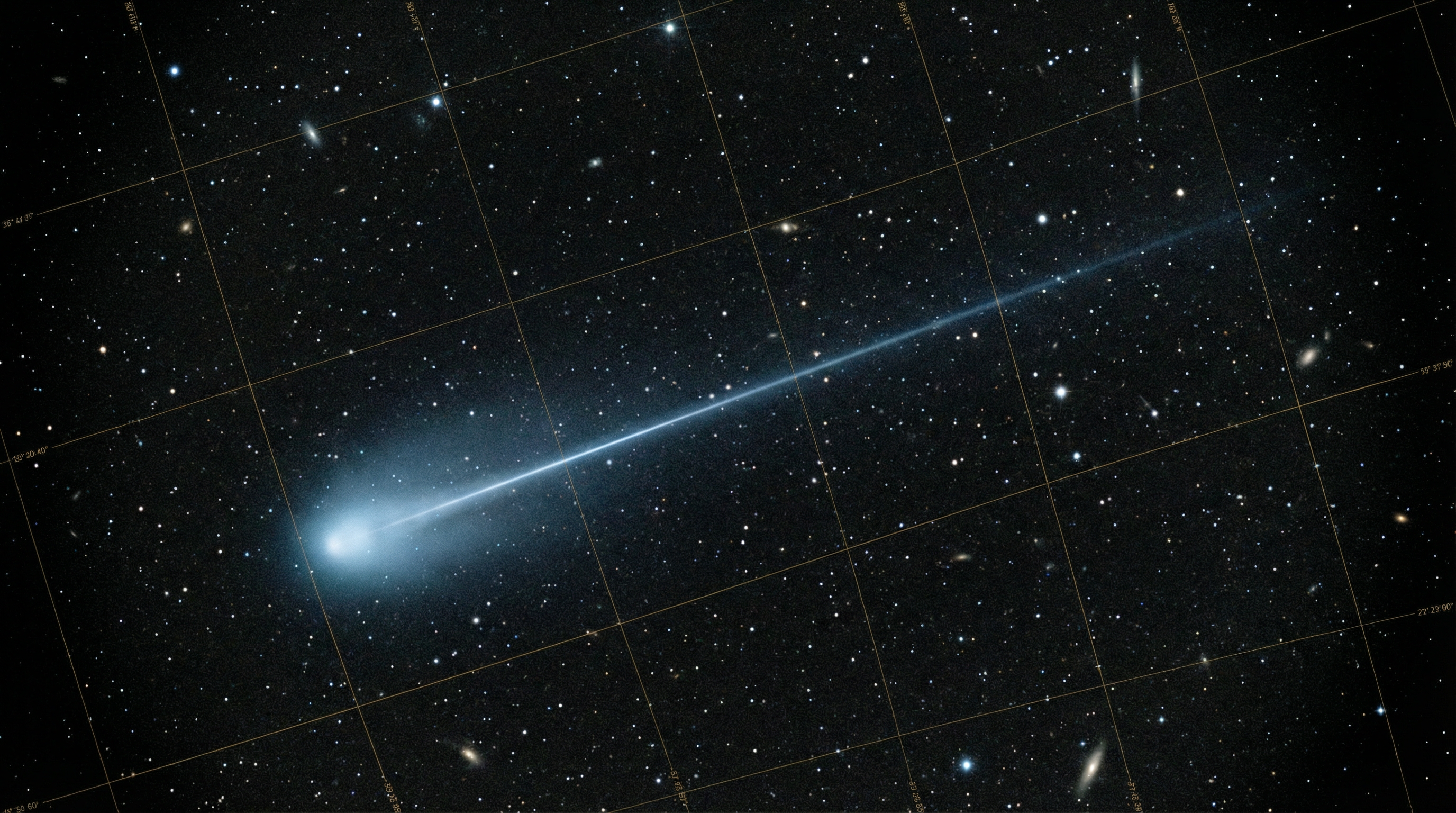
3I/ATLAS hyperbolic trajectory // long-exposure CCD observatory capture // astrometric grid overlay // ATLAS Division
On July 1, 2025, the Asteroid Terrestrial-impact Last Alert System (ATLAS) survey detected an object on a hyperbolic trajectory with an eccentricity far exceeding anything produced by solar system dynamics alone. Designated 3I/ATLAS — the third confirmed interstellar object to transit the inner solar system — it arrived at a velocity inconsistent with gravitational acceleration from any known stellar source within the plausible inbound trajectory.
That anomaly is the starting point for ATLAS Division research. The kinematic profile of 3I/ATLAS does not fit the standard model for interstellar objects. This dispatch describes what the May 2026 periapsis window represents, what measurements ATLAS Division is prioritizing, and why the next several weeks constitute a non-repeatable observational opportunity.
The Object: Confirmed Anomalies in the Kinematic Record
Three properties of 3I/ATLAS place it outside the distribution of known interstellar objects and merit sustained scientific attention.
The eccentricity value is the most immediately significant. Oumuamua's eccentricity of 1.20 was already anomalous enough to generate years of debate about non-gravitational acceleration. Borisov at 3.36 was more comfortably explained as a cometary body with a high-velocity stellar origin. At approximately 6.8, 3I/ATLAS requires an explanation that existing interstellar object models do not provide.
The excess velocity — the component of the object's speed that cannot be accounted for by solar gravitational acceleration alone — compounds this. A body arriving at 60 km/s above escape velocity from a plausible stellar source is not simply a fast rock. It carries kinematic energy that demands accounting.
What ATLAS Division Is Measuring
ATLAS Division research on 3I/ATLAS is organized around three measurement priorities, each targeting a specific falsifiable claim about the object's kinematic history.
Non-Gravitational Acceleration Profile
The central question for any anomalous interstellar object is whether its observed trajectory can be fully explained by gravitational forces alone. For 3I/ATLAS, the answer is currently no. ATLAS Division is tracking the residuals between the gravitational-only trajectory model and the observed positional data as the object approaches periapsis. A non-gravitational acceleration term that cannot be explained by outgassing or radiation pressure would be a significant finding.
Rotational State and Tumbling Dynamics
Oumuamua's anomalous non-gravitational acceleration was partially attributed to anisotropic outgassing, a model that requires a specific rotational state. 3I/ATLAS presents an opportunity to test whether similar explanations apply at higher eccentricity. Rotational period and axis orientation measurements during the periapsis window will constrain the outgassing hypothesis for this object.
Spectral Composition and Surface Properties
High-resolution spectroscopy during the periapsis window will yield the best available data on surface composition. ATLAS Division is specifically interested in whether the spectral profile is consistent with known cometary or asteroidal compositions, or whether it presents features that fall outside the established distribution. This connects directly to the IAF methodology — if physical samples were ever recoverable, the D_iso coefficient would provide the forensic standard for evaluating them.
Why This Window Is Non-Repeatable
Interstellar objects do not return. Once 3I/ATLAS completes its periapsis passage and begins its outbound trajectory, the observational window closes permanently. The object will never again be this close to Earth-based instrumentation. Every week of delay in coordinating observations is a reduction in the quality of the dataset that will define this object's scientific legacy.
The periapsis window is also the period of maximum angular velocity — the object moves fastest relative to the background sky, which demands rapid-cadence astrometry to maintain positional accuracy. Ground-based observatories with large apertures and space-based assets with UV/IR capability are both relevant. ATLAS Division is actively seeking coordination with research teams that have access to either.
There is a secondary urgency that is less often discussed: the post-periapsis outbound phase will show whether the object's trajectory deviates from the inbound prediction. If the outbound eccentricity differs measurably from the inbound value — even by a small amount — that deviation would be a direct measurement of energy exchange during the solar passage. No known physical mechanism produces such an exchange for a passive body. Detecting it would require continuous high-precision astrometry through and beyond periapsis.
The Connection to IAF Methodology
ATLAS Division research and the IAF methodology developed under the Aerospace Forensics program are not parallel tracks. They are designed to converge.
The kinematic anomalies of 3I/ATLAS raise a specific question: if this object, or objects like it, have deposited material in the solar system — through ablation, ejecta, or direct impact — what would that material look like? The answer, under the IAF framework, is that it would carry an isotopic signature inconsistent with any known terrestrial or solar system formation pathway. The D_iso coefficient would be elevated above the 0.5 falsification threshold.
This is not a speculative connection. The Ubatuba magnesium fragment — the initial demonstration case for IAF methodology — was recovered in 1957 and has been documented in the materials science literature for decades. Its D_iso value of approximately 0.77 places it well above the falsification threshold. Whether that sample is connected to any specific interstellar object is a separate question. What IAF establishes is the forensic standard by which such a connection could, in principle, be evaluated.
The May 2026 periapsis window is therefore relevant to both divisions simultaneously. Kinematic data from ATLAS constrains the object's trajectory and energy budget. Spectral data constrains its composition. And the IAF methodology provides the forensic framework for evaluating any recovered material against the hypothesis that it originated outside the solar system.
Coordination and Collaboration
ATLAS Division is actively seeking collaboration with research teams in the following areas:
- Astrometry networks — high-cadence positional measurements through and beyond periapsis to detect trajectory residuals and potential post-periapsis deviations.
- High-resolution spectroscopy — surface composition analysis during the periapsis window when signal-to-noise is at maximum.
- NanoSIMS / SIMS instrumentation access — for application of the IAF methodology to any relevant sample archives, including existing meteoritic and presolar grain datasets that may provide baseline comparison data.
- Defense and intelligence community liaisons — for coordination on any classified observational datasets that may be relevant to the kinematic record.
BRSS operates under commercial classification. All research outputs are intended for open publication. Collaboration agreements can be structured to accommodate institutional requirements.
The May 2026 periapsis window is the active validation period. The dataset it produces will define what we know about this object for the remainder of its observable lifetime. Now is the time to coordinate.
About the Author
Kevin Thorsen Baird
Principal Investigator // Baird Research & Strategic Sciences, LLC & Director, ATLAS Division
Kevin Thorsen Baird is Principal Investigator at Baird Research & Strategic Sciences LLC and Director of the ATLAS Division. His research focuses on anomalous kinematics, interstellar object trajectory analysis, and the intersection of aerospace forensics with materials provenance methodology. Correspondence: [email protected]
ORCID: 0009-0001-7938-446X
ATLAS DIVISION FIELD DISPATCH // CLASSIFICATION: COMMERCIAL / INDUSTRIAL DISSEMINATION.
JBIS PREPRINT AVAILABLE VIA ZENODO: ZENODO.ORG/RECORDS/18735095.
© 2026 BAIRD RESEARCH & STRATEGIC SCIENCES, LLC. ALL RIGHTS RESERVED.