BAIRD RESEARCH TECHNICAL REPORT // C4-TR-26-001

Isotopic Topology as a Thermodynamically Unclonable Anchor for Supply Chain Security

Throughput Asymmetry Constraints in Non-Equilibrium Metallic Gradients

Kevin Thorsen Baird
Baird Research & Strategic Sciences, LLC
The C4 Institute
ORCID: 0009-0001-7938-446X
Published: February 9, 2026
License: CC-BY 4.0

ABSTRACT

The global semiconductor supply chain faces a critical vulnerability: counterfeit components and hardware trojans circumvent existing digital cryptographic protections. Current solutions, such as Silicon Physically Unclonable Functions (PUFs), rely on stochastic manufacturing variations that are susceptible to aging, thermal drift, and modeling attacks. This report introduces Isotopic Topology Authentication, a novel hardware assurance framework based on nuclear binding energy. By embedding non-equilibrium gradients of stable isotopes (e.g., 62Ni vs. 58Ni) within metallic interconnects, we create thermodynamically unclonable "Physical Anchors." We demonstrate that while these gradients are chemically identical to standard interconnects, replicating the specific isotopic vector field requires atom-by-atom serial assembly. We quantify the resulting security barrier as a throughput asymmetry of 107, rendering cloning economically irrational. Simulation results confirm that these gradients are detectable via field-deployable Laser-Induced Breakdown Spectroscopy (LIBS) with a signal recovery confidence of >99% (Diso > 25.0) under 5% sensor noise.

Keywords: Hardware Assurance, Zero Trust Manufacturing, Isotopic Fingerprinting, Focused Ion Beam, Anti-Counterfeiting

1. Introduction

The integrity of the global semiconductor supply chain is increasingly compromised by the injection of counterfeit components, recycled die, and malicious hardware modifications. The economic impact is estimated at $7.5 billion annually, but the national security implications of compromised defense systems are incalculable.

1.1 Limitations of Current Art

Existing hardware assurance mechanisms rely primarily on electron transport phenomena. As illustrated in Table 1, current state-of-the-art solutions suffer from inherent trade-offs between stability, clonability, and detectability.

Table 1: Comparative Analysis of Hardware Assurance Technologies
TechnologyEntropy SourceStabilityPrimary Vulnerability
Silicon PUF
(SRAM/Arbiter)
Transistor threshold voltage (ΔVth)Low (5-10 yrs)
Susceptible to aging
Modeling Attacks: Machine Learning can predict responses; Thermal drift causes false negatives.
Optical Tags
(Holograms)
Refractive index patternsMedium
Surface degradable
Decoupling: Tag secures the package, not the die. Easily swapped.
DNA/BiologicalMolecular sequenceVery Low
Thermally fragile
Thermal Limit: Destroyed by standard reflow soldering (>260°C).
Isotopic Topology
(This Work)
Nuclear Binding Energy
(Isotope Ratio)
High
(>100 yrs @ 85°C)
None Identified: Chemically invisible and thermodynamically hard to clone.

The Physicochemical Gap: There is a need for a security primitive that is independent of electronic functionality and stable over decadal-to-centennial time scales. This report proposes shifting the root of trust from the electron shell (chemistry/electronics) to the nucleus (physics).

2. Methodology: Isotopic Fingerprinting

We introduce a method to encode information in the Isotopic Landscape of a material. Unlike standard doping, which alters the chemical composition (e.g., Boron in Silicon), this method alters the ratio of stable isotopes within a chemically pure metal.

2.1 The Non-Equilibrium Gradient

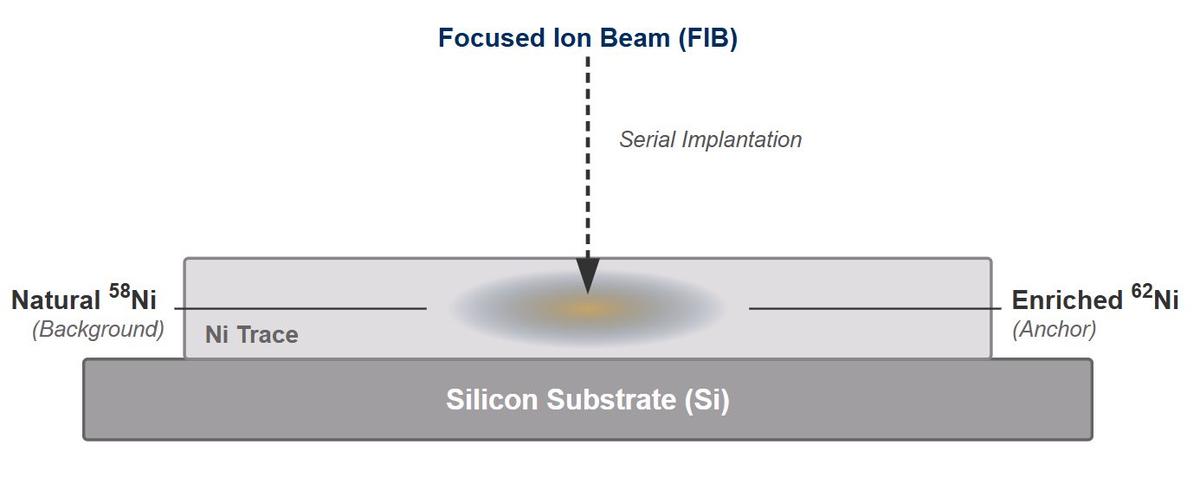
Standard metallization processes result in a homogeneous mix of isotopes based on terrestrial natural abundance (e.g., Nickel is nominally 68% 58Ni). Our approach utilizes Focused Ion Beam (FIB) implantation to create localized, non-equilibrium gradients where the concentration of a minority isotope (e.g., 62Ni) deviates significantly from the natural background.

Conceptual model of the Isotopic Anchor
Figure 1: Conceptual model of the Isotopic Anchor. The gradient is defined by the spatial derivative of the isotopic ratio R = [62Ni] / [58Ni]. This physical topology serves as the static identifier, which is thermodynamically difficult to clone via bulk deposition methods.

2.2 Security Model: Work of Separation

The security of the tag is derived from the Thermodynamic Work of Separation. To clone the tag, an adversary cannot simply use bulk alloy deposition. They must separate isotopes and deposit them with spatial precision matching the original gradient.

Given the flux limits of liquid metal ion sources, replicating a 100 μm² gradient via serial writing requires approximately 106 to 107 seconds (11–115 days), creating a prohibitive Throughput Asymmetry compared to the legitimate batch-masking process (<1 second effective time per die).

2.3 Thermal Stability (Arrhenius Model)

A critical requirement for semiconductor assurance is survivability under high-temperature operating conditions. The isotopic gradient relies on the slow self-diffusion of Nickel in the Silicon lattice.

Table 2: Predicted Gradient Stability (Arrhenius Extrapolation for Ni-Si System)
ConditionTemperatureEstimated Stability
Storage / Ambient25°C> 1000 Years
Standard Operation85°C> 100 Years
High Stress100°C≈ 30 Years
Reflow Soldering260°CStable for < 5 Minutes (Process Safe)

3. Computational Validation

To validate the detectability of these gradients without laboratory-grade mass spectrometry, we simulated the spectral response of a portable Laser-Induced Breakdown Spectroscopy (LIBS) system.

3.1 Simulation Parameters

We modeled the interaction of a 1064 nm pulsed laser (5 mJ) with the isotopic target:

  • Target: Silicon substrate with Ni metallization (62Ni peak: 80%).
  • Sensor Noise: A Gaussian noise floor of 5% was applied to the spectral intensity to simulate thermal noise in a non-cooled CCD detector.
  • Ablation Volume: Modeled as a 10 μm diameter crater.

3.2 The Drift Index (Diso)

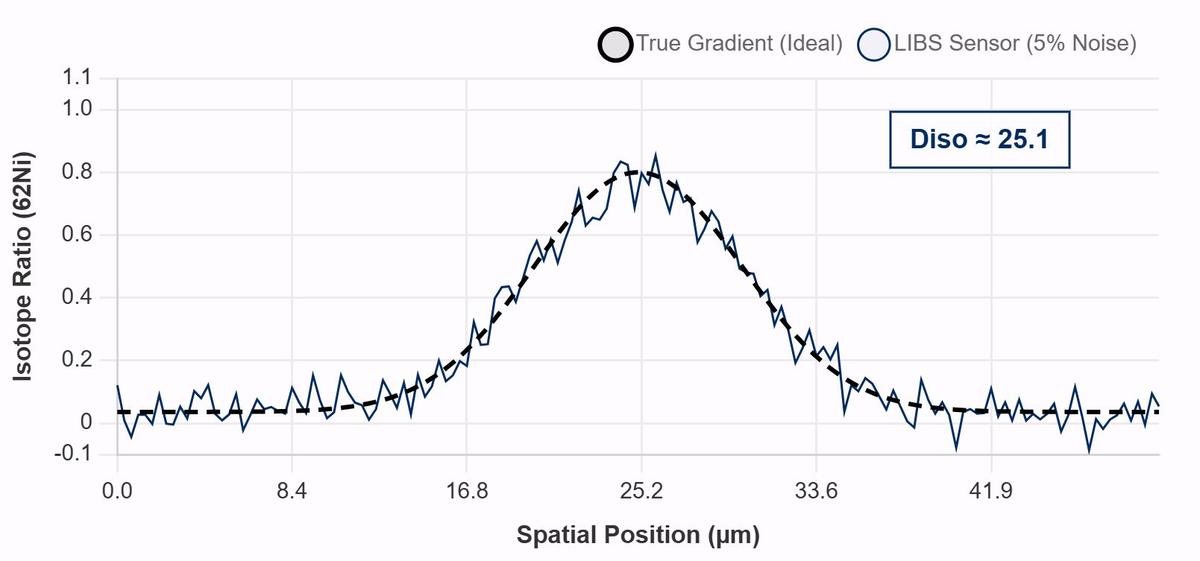
Simulation results indicate that even with 5% system noise, the recovered signal yields a Diso of 25.1, well above the reliable detection threshold of 5.0. This confirms that field verification is feasible using commercial handheld spectrometers.

Simulation of isotopic signal recovery under noise
Figure 2: Simulation of signal recovery. The authentic isotopic profile remains statistically significant despite the Gaussian noise floor of a standard handheld spectrometer (Diso ≈ 25.1). The dashed line represents the ideal gradient, while the solid line represents sensor data with 5% noise.

4. Proposed Deployment Architecture

The physical permanence of Isotopic Topology suggests a "Depot-First" deployment model for high-assurance sectors.

4.1 The Logistics Depot Gateway

Rather than requiring verification at the end-user level, we propose implementation at logistics chokepoints (e.g., Defense Logistics Agency depots). A benchtop LIBS unit screens 100% of incoming FPGA and ASIC inventory.

  1. Scan: The laser ablates a sacrificial zone on the chip package.
  2. Compute: The system calculates the local isotopic ratio.
  3. Verify: The Diso is compared against the immutable blockchain record of the manufacturer's fabrication data.

4.2 Sacrificial Integration

To prevent damage to active circuitry, the tag is designed for placement on the package heat spreader or the scribe line of the die. This ensures that the destructive nature of LIBS analysis does not compromise device reliability or hermeticity.

5. Conclusion & Future Work

Isotopic Topology represents a paradigm shift in hardware assurance. By leveraging the immutable laws of nuclear physics, we establish a root of trust that is resistant to the cloning and aging vulnerabilities that plague electronic security primitives. The calculated Throughput Asymmetry (106–107 seconds cloning time vs. <1 second legitimate) provides a robust economic barrier against counterfeiting, securing critical infrastructure against advanced persistent threats.

Future work focuses on the empirical validation of these simulation results, specifically the fabrication of 62Ni gradients on silicon wafers and independent failure analysis to empirically validate the 104-day cloning barrier.

References

  1. E. M. Blass and W. Blume-Kohout, "Counterfeits in semiconductor supply chains: prevalence and vulnerabilities," IEEE J. Emerging Sel. Topics Power Electron., vol. 8, no. 4, pp. 3845--3854, 2020.
  2. U.S. GAO Report, "Counterfeit Electronics: Extent of Problem and Federal Actions Needed to Address Risks to the Department of Defense," GAO-12-127, 2012.
  3. S. Katzenbeisser et al., "PUFs: Myth or reality?," IEEE Trans. Dependable Secure Comput., vol. 11, no. 6, pp. 511--523, 2013.
  4. P. Tuyls and I. Verbauwhede, "Side-channel attacks on physically unclonable functions," IEEE Trans. Very Large Scale Integr. Syst., vol. 17, no. 3, pp. 425--437, 2009.
  5. B. M. Wacaser et al., "Deterministic and directed growth of Si nanowires," J. Cryst. Growth, vol. 287, no. 2, pp. 354--360, 2006.
  6. J. F. Ziegler, M. D. Ziegler, and J. P. Biersack, "SRIM---the stopping and range of ions in matter (2010)," Nucl. Instrum. Methods Phys. Res. B, vol. 268, no. 11, pp. 1818--1823, 2010.

Cite This Work

Kevin Thorsen Baird. (2026). Isotopic Topology as a Thermodynamically Unclonable Anchor for Supply Chain Security. Baird Research Technical Report C4-TR-26-001. DOI: 10.5281/zenodo.18564494
PROJECT IRONCLAD // HARDWARE ASSURANCE

Interested in Isotopic Topology for Your Supply Chain?

Contact Baird Research to discuss pilot programs, technical partnerships, or licensing opportunities for defense and critical infrastructure applications.

Request Briefing